

How to Choose the Right Mosaic Tile for a Curbless Shower
A curbless shower has no raised threshold to interrupt the bathroom floor, so the shower floor and its transition need careful planning. The tile must work with the required slope, fit the drain layout, and create a practical transition to the surrounding floor. That makes mosaic tile a useful category to investigate, but not every mosaic is equally well suited to the job.
The best mosaic tile for a curbless shower depends on more than color or pattern. Size, material, surface finish, grout joints, drainage, maintenance, and installation conditions all matter. This guide explains how to compare those factors before ordering tile or finalizing a layout.
To begin comparing styles and materials, you can shop mosaic tiles and then narrow the options using the project criteria below.
Why tile size matters on a curbless shower floor
Format & Layout
Choose a surface that supports the project’s practical needs
Application Guide
Compare common mosaic material options
Selection Guide
Why tile size matters on a curbless shower floor
A shower floor is typically formed with a slope toward the drain. Smaller mosaic pieces can follow changes in the plane more readily than large-format tiles because the installation contains more individual joints. That flexibility can be especially helpful when the drain is positioned within the shower floor or when the floor has more than one directional transition.
Small format does not automatically make a tile suitable. The tile still needs to be appropriate for the intended wet-area application according to its manufacturer, and the installation must provide a properly prepared, waterproofed, and sloped surface. A tile’s size cannot correct a drainage or substrate problem.
Very small mosaics also create more grout joints. Those joints influence the visual pattern, cleaning routine, and amount of installation work. Before choosing a dense pattern, consider whether the appearance and maintenance expectations fit the household.
Choose a surface that supports the project’s practical needs
Surface texture deserves close attention in a curbless shower. A polished surface may create a different underfoot experience from a honed, matte, textured, or tumbled surface, but the finish alone should not be treated as proof of slip resistance. Ask for the tile’s applicable technical information and discuss the choice with a qualified installer who understands the project conditions and local requirements.
Some mosaics are supplied on mesh sheets. Mesh-backed sheets can make pattern placement more efficient, but the installer still needs to manage sheet seams, joint spacing, cuts, and alignment so the finished floor does not reveal a repeated grid. The bonding method and mesh construction should be compatible with the installation system being used.
Bring samples into the room if possible. Bathroom lighting, grout color, and the scale of the floor can make a sample look different from an online image. With natural stone, expect variation in color, movement, texture, and pattern; one sample can help establish the general character but cannot represent every piece in the finished installation.
Compare common mosaic material options
Natural stone mosaics
Marble, travertine, limestone, and other natural stones can provide variation that manufactured materials do not reproduce exactly. They also require a more deliberate maintenance discussion. Confirm that the selected stone is appropriate for the intended application, follow the product and installation guidance, and use cleaning methods suitable for that stone.
Sealing may be part of a natural-stone care plan, but it does not make stone waterproof, stain-proof, etch-proof, or maintenance-free. Acidic cleaners can be unsuitable for acid-sensitive stones such as marble and limestone, so cleaner selection should be based on the material rather than on a general bathroom-cleaning assumption.
Porcelain and ceramic mosaics
Porcelain and ceramic mosaics offer a broad range of colors, patterns, and finishes. Their suitability still depends on the specific tile and the manufacturer’s stated application information. Do not assume that a tile is appropriate for a shower floor simply because it is sold as a mosaic or is commonly used on walls.
Compare the actual product documentation, including intended use and care instructions, before committing to a large order. If the available information does not answer a wet-area question, ask the supplier or manufacturer rather than relying on appearance alone.
Think about grout as part of the floor design
Grout affects both the appearance and daily upkeep of a mosaic shower floor. A contrasting grout can emphasize each piece and make the pattern more prominent. A closer color match can create a quieter field, although it will not eliminate the need for routine cleaning.
Grout selection should be coordinated with the tile, joint dimensions, cleaning expectations, and installation system. The grout is not a substitute for waterproofing, and a water-resistant grout claim should not be interpreted as making the shower assembly waterproof. Waterproofing is handled by the appropriate underlying system and detailing, not by the visible tile surface alone.
Ask the installer how the selected grout will be used in the specific assembly, including around changes of plane and at movement joints. General product advice cannot replace the manufacturer’s instructions or project-specific installation guidance.
Coordinate the mosaic with the drain and room transition
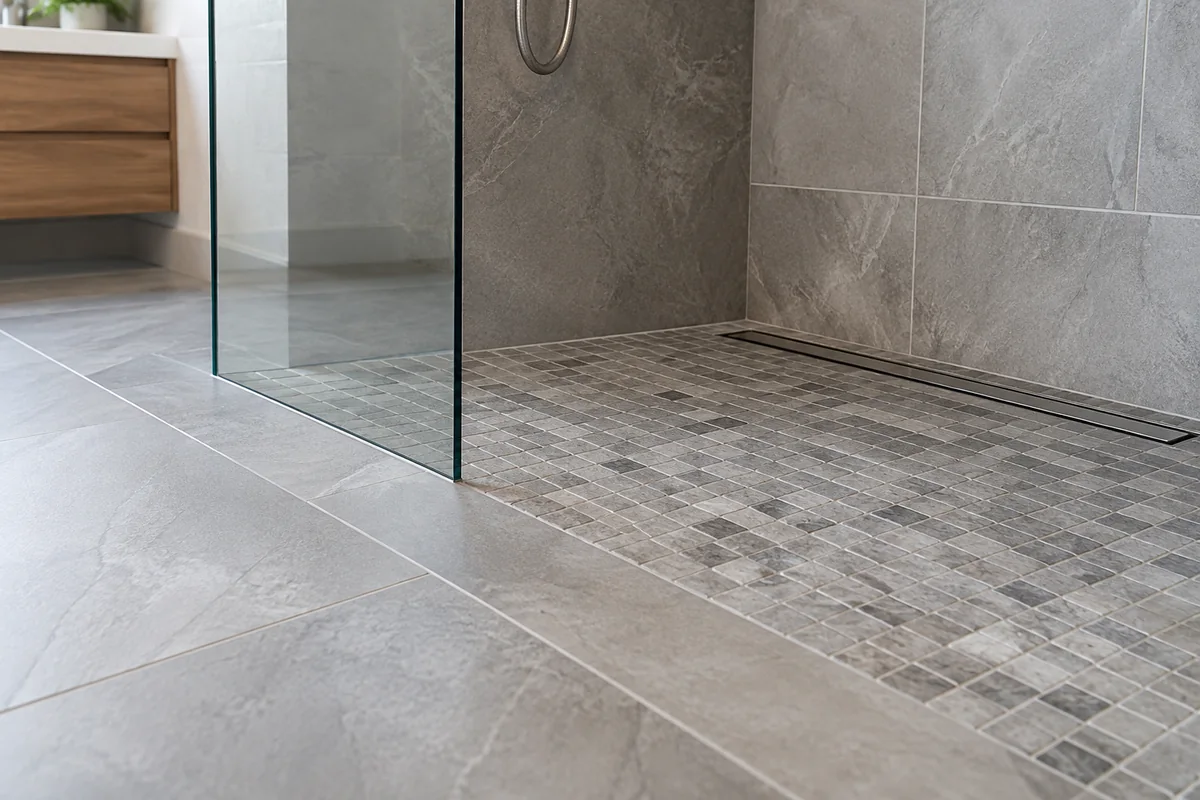
Curbless showers often require close coordination among the shower footprint, bathroom floor, doorway, and drain. The tile layout should be considered before installation begins, especially if the mosaic has a directional pattern or a strong repeating motif.
- Drain position: The drain location influences how the floor slopes and where cuts may appear. A layout that looks balanced on a sample board may require a different arrangement around the actual drain.
- Shower entry: The transition should be planned so the bathroom floor and shower floor meet cleanly without creating an unintended ridge or low spot.
- Pattern direction: Repeating mosaics need careful sheet placement. Discuss how the pattern will align at the entry, walls, corners, and drain.
- Cut pieces: Ask where cuts will be placed and whether the border or perimeter will require a deliberate framing detail.
These decisions are installation-specific. A qualified installer should verify the substrate, slope, waterproofing details, drain assembly, and transition before tile is set. Building requirements and manufacturer instructions also need to be followed for the particular project.
Use samples to evaluate more than color
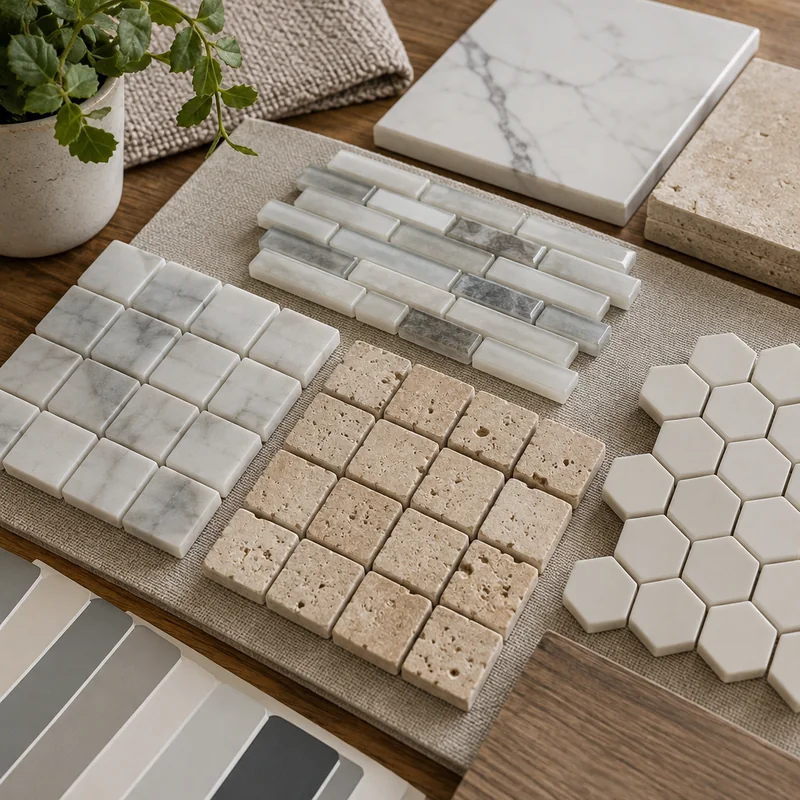
Order or inspect samples with the whole installation in mind. Place them near the proposed wall tile and bathroom floor, then view them under the room’s actual lighting. Look at the apparent scale of the mosaic, the amount of grout, the edge treatment, and how easily the pattern may be interrupted by cuts.
For natural stone, inspect more than one piece when available. Variation is an inherent material characteristic, and a single sample cannot show the complete range of veining or shade that may appear across a floor. If consistency is especially important, discuss acceptable variation before ordering and installation.
It is also worth considering the cleaning tools and products the household already uses. Textured surfaces, numerous grout joints, and porous natural materials can have different care requirements. Confirm the recommended cleaning approach before choosing a tile based only on its visual appeal.
Review more than one sample or the expected variation range whenever possible, especially when veining or movement is visually prominent.
Questions to ask before buying
A short conversation with the tile supplier and installer can prevent an expensive mismatch. Ask:
- Is this specific tile identified by its manufacturer for the intended shower-floor application?
- What care and cleaning methods are recommended for this material and finish?
- How will the tile accommodate the planned slope and drain location?
- What grout and setting system are compatible with the tile and substrate?
- How will the transition between the shower floor and the surrounding bathroom floor be detailed?
- Will the natural stone show meaningful variation, and can additional samples be reviewed?
For a broader discussion of formats, materials, and design considerations, the mosaic tile selection guide can help organize your comparison.
Common mistakes to avoid
One common mistake is selecting a mosaic solely because it is small. Small pieces may be easier to arrange over a sloped surface, but they do not replace proper waterproofing, drainage, or a suitable product designation. Another is choosing a finish based on a showroom sample without considering how grout, water, lighting, and cleaning will affect the completed floor.
It is also easy to overlook the layout until after the tile has been purchased. Strong patterns, narrow borders, and sheet-mounted mosaics may need advance planning around the drain and entry. Finally, avoid assuming that a sealer or grout can solve every maintenance or water-management concern. Each part of the assembly has a distinct purpose.
For more focused comparison of size, finish, and material considerations, review this resource on mosaic tiles for shower floors.
Final decision checklist
A suitable choice for a curbless shower should satisfy several requirements at once: the specific tile should be approved for its intended application, its format should work with the planned slope and drain, its surface and grout should fit the household’s maintenance expectations, and its color and pattern should coordinate with the surrounding floor and walls.
Before ordering, compare samples, review the available technical and care information, and have the installer assess the project conditions. The right decision is not simply the smallest or most attractive mosaic; it is the option that works as part of the complete shower assembly and remains practical to live with.
Frequently asked questions
Quick answers to practical selection, installation, care, and planning questions.
Is smaller mosaic tile always better for a curbless shower?
No. Smaller pieces can make it easier to follow a sloped floor, but the tile must still be suitable for the intended application and compatible with the installation system. Drainage, waterproofing, substrate preparation, and layout remain essential.
Can large-format tile be used on a curbless shower floor?
That depends on the floor geometry, drain design, tile, and installation method. Large pieces may be more difficult to fit over changes in slope, so the proposed layout should be reviewed by a qualified installer before the material is selected.
Does mosaic grout make a shower floor slip-resistant?
Grout joints can affect the underfoot feel, but grout quantity alone is not a reliable performance rating. Review the specific tile information and obtain project-specific guidance rather than assuming that any mosaic provides the same traction.
Should natural stone mosaic tile be sealed?
Sealing requirements vary by stone, finish, installation, and manufacturer guidance. If sealing is recommended, it should be viewed as part of maintenance—not as a guarantee against water, stains, etching, or future care.
Find the Right Tile or Stone for Your Project
Browse Stone Market USA collections or contact our team for help comparing materials, finishes, applications, samples, quantities, and current availability.