

Natural Stone Sealer Test: How to Tell Whether a Surface Needs Resealing
Knowing how to tell if natural stone needs sealing is less about following a fixed calendar and more about checking how the surface responds to moisture. A countertop, floor, shower wall, or backsplash may need attention at a different interval depending on the stone, finish, location, cleaning routine, and sealer previously used.
A simple water-drop test can provide a useful first indication, but it is not a complete diagnosis. The test must be performed on a clean, dry area and interpreted with the stone’s finish and condition in mind. This guide explains how to test the surface, what the results mean, and when resealing will not solve the problem.
What sealing does—and what it does not do
Care & Maintenance
The basic water-drop test
Material Guidance
How to interpret the result
Material Guidance
What sealing does—and what it does not do
Most sealers used on natural stone are intended to reduce the absorption of liquids into the stone. That can give you more time to wipe up a spill, but sealing does not make stone stain-proof, waterproof, maintenance-free, or resistant to every type of damage.
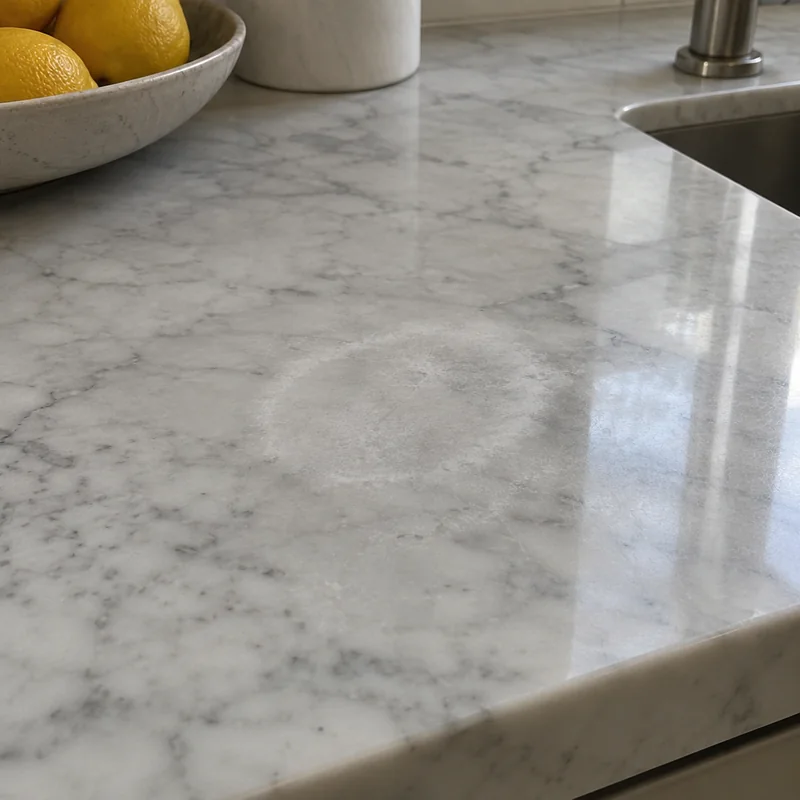
Sealing also does not prevent etching. Acidic substances can chemically alter acid-sensitive materials such as marble, limestone, and some other calcareous stones. A sealer may reduce absorption, but it will not restore an etched finish or eliminate the need for appropriate cleaning practices.
Natural stone is not uniform. Two pieces of the same material can vary in porosity, veining, texture, and finish, so one section may respond differently from another. A test should therefore be performed in several representative areas rather than at only one convenient spot.
The basic water-drop test
The water-drop test is a practical screening method for many unfinished or penetrating-sealer applications. It helps you observe whether moisture is being absorbed readily at the surface.
- Choose a discreet area. Test beneath an appliance edge, behind a small countertop item, or in another inconspicuous location. Do not begin in the most visible part of the installation.
- Clean the surface first. Remove ordinary dirt, food residue, soap film, and cleaner residue using a cleaning method appropriate for the stone. Allow the area to dry completely. Testing a damp or recently cleaned surface can produce a misleading result.
- Apply a small amount of plain water. Place a few drops on the stone, keeping the test away from an open crack or grout joint when possible.
- Observe the area. Watch for several minutes and compare the test spot with nearby dry stone. Look for darkening, a spreading damp mark, or other visible absorption.
- Blot and inspect. Remove the water and check whether the stone returns to its original appearance after drying. If the area darkens temporarily, note how quickly that change occurs and how long it takes to disappear.
Repeat the test on different sections, especially in locations exposed to more water or spills. A kitchen work zone, bathroom vanity, shower-adjacent wall, and low-traffic backsplash may have different maintenance needs.
How to interpret the result
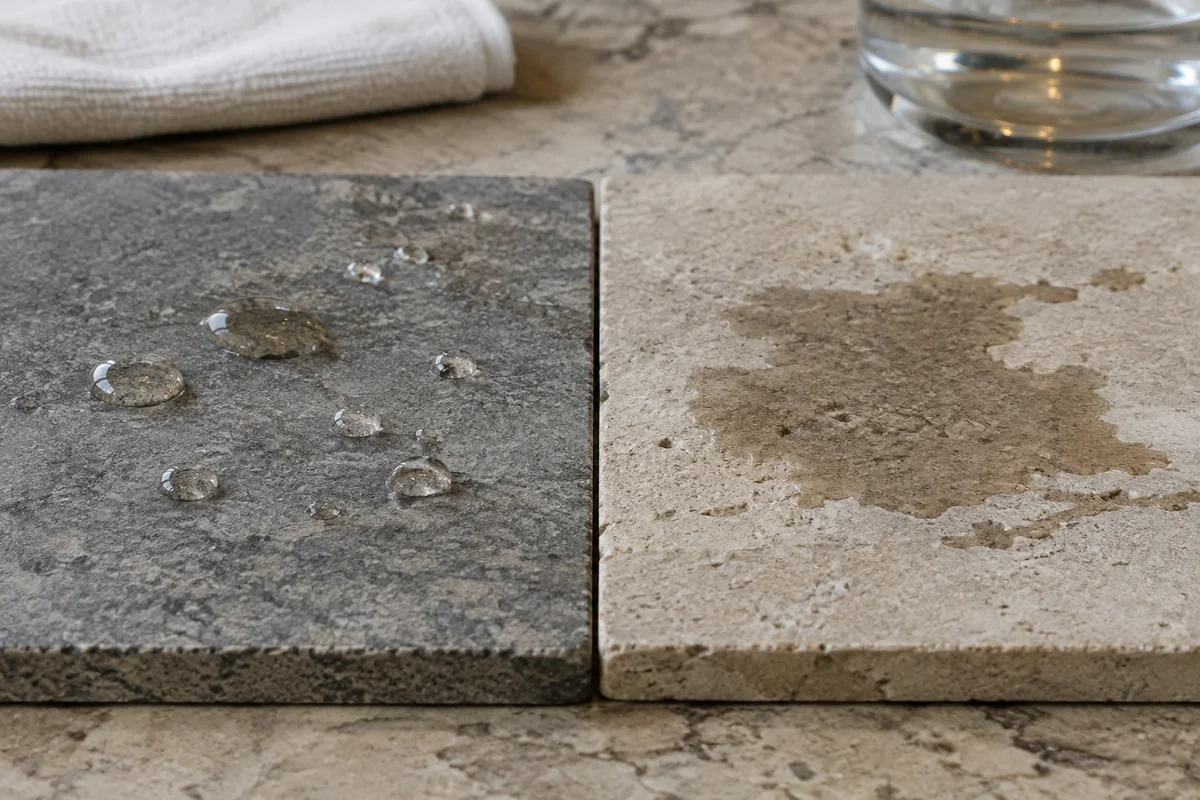
If the water beads and remains on the surface
Beading suggests that the surface is currently resisting that small amount of moisture. It may indicate that a sealer or another surface treatment is still present, but it does not prove that the entire installation is adequately protected. Surface texture, dust, oils, polish, and a topical coating can also affect how water behaves.
Do not assume that a beading result means the stone never needs inspection. Continue checking high-use areas and follow the care guidance associated with the specific stone and sealer, if known.
If the stone darkens slowly
Slow darkening usually indicates that some moisture is entering the stone. That does not automatically mean the sealer has failed. Some stones remain somewhat absorbent even after treatment, and a brief change in color may disappear as the water evaporates.
The more useful question is whether the stone absorbs quickly in a frequently exposed area and whether the darkened mark persists unusually long after the water is removed. Compare the result with a nearby section and avoid judging the test while the stone is still naturally damp.
If the stone darkens quickly
Rapid, obvious darkening indicates that the surface is readily accepting water at that location. This may mean the stone is unsealed, that an earlier treatment has worn down, or that the material is naturally quite absorbent. Before applying a new sealer, confirm that the surface is clean, dry, and free from incompatible residue.
A strong absorption result is a reason to investigate further, not a reason to apply multiple coats immediately. Excess sealer can leave residue, create an uneven appearance, or cause other application problems when the product and surface are not compatible.
Why the test can be misleading
A water test is useful, but several conditions can distort the result:
- Polished stone: A highly polished surface may absorb water differently from a honed, brushed, tumbled, or textured finish. Surface finish is one reason to compare like areas rather than relying on a generic expectation.
- Topical coatings: A film-forming treatment, wax, or residue can cause water to bead even when the underlying condition is unknown. It may also affect how a new sealer bonds or appears.
- Cleaner residue: Soap, oils, and some maintenance products can temporarily change the surface’s behavior.
- Existing moisture: Stone that has recently been mopped, exposed to a leak, or installed over a damp area cannot be evaluated reliably until it has dried.
- Grout and joints: Grout may absorb water differently from the stone. Test the stone and grout separately if both need evaluation.
- Uneven wear: Walkways, sink areas, cooking zones, and shower edges often experience more exposure than protected sections.
If the result is inconsistent or the surface has an unknown coating, professional evaluation may be more useful than repeated home testing. Manufacturer instructions for the existing sealer and the stone itself should take priority over a general schedule.
Signs that a surface may need more than resealing
Not every discoloration or change in appearance is a sealing issue. Resealing may not correct:
- Etching, dull spots, or chemical damage on acid-sensitive stone
- Deep stains that have already penetrated the material
- Cracks, loose tiles, hollow-sounding areas, or movement-related damage
- Persistent moisture caused by a leak, condensation, or an installation problem
- Residue, wax buildup, or an incompatible topical coating
- Surface wear caused by traffic, abrasion, or unsuitable cleaning methods
For these conditions, the appropriate next step may involve specialized cleaning, coating removal, honing or polishing, repair, moisture investigation, or advice from a qualified stone professional. Applying more sealer without identifying the cause can make the appearance harder to correct.
When to test and when to reseal
Test the surface when you notice faster absorption, recurring dark spots after spills, or a change in how water behaves. Testing is also sensible before a major maintenance project or after cleaning away a coating, provided the surface has dried fully.
A calendar alone is not a reliable resealing rule for every natural stone installation. Material porosity, finish, exposure, traffic, ventilation, cleaning habits, and the specific sealer all matter. A low-use decorative wall and a heavily used kitchen surface should not automatically be treated as though they experience the same conditions.
Before resealing, identify the stone and finish if possible, read the sealer’s directions, and verify preparation requirements. Test any sealer in an inconspicuous area first. Follow the stated application and curing instructions rather than assuming that additional product will provide additional protection.
For a broader upkeep plan covering routine cleaning, spill response, and periodic checks, review this natural stone tile maintenance guide. It can help place a resealing test within the larger care routine instead of treating sealing as the only maintenance task.
Surface finish matters during evaluation
Finish affects texture, reflectivity, slip underfoot, visual variation, and how a surface shows water or residue. A honed surface may make a temporary darkening easier to see than a more reflective finish, while a textured or tumbled surface can make it difficult to judge absorption consistently. Reviewing natural stone finishes explained can help you distinguish a finish-related appearance change from a sign that the stone needs treatment.
Samples are useful when comparing finishes, but a sample cannot represent every piece in a natural-stone installation. Existing stone may vary in color, veining, movement, and porosity, so evaluate the installed surface whenever the question concerns maintenance.
A practical decision checklist
Use these questions before deciding to reseal:
- Is the stone clean and completely dry?
- Did several representative areas produce a similar result?
- Is the tested area exposed to more water or spills than the rest?
- Could a topical coating, wax, oil, or cleaner residue be affecting the result?
- Are you seeing absorption, or are you actually dealing with etching, a stain, cracking, or ongoing moisture?
- Do you know the stone type, finish, and previously used sealer?
- Have you checked the current sealer’s instructions before applying anything new?
The most dependable approach is to use the water-drop test as an observation tool, not as a standalone command to reseal. If the result is clear and the surface is otherwise sound, it can support a maintenance decision. If the result is confusing or the stone has visible damage, pause and identify the underlying condition first.
Frequently asked questions
Quick answers to practical selection, installation, care, and planning questions.
How often should natural stone be resealed?
There is no single interval that applies to every stone, finish, room, and sealer. Inspect the surface and follow the instructions for the specific sealer and installation rather than relying only on an annual rule.
Can I use oil instead of water for a sealer test?
Oil can create a stain or leave residue, making the result harder to interpret and potentially complicating later treatment. A small water-drop test is generally a simpler first check, but it still needs to be performed on a clean, dry, inconspicuous area.
Does water beading prove that my stone is sealed?
No. Beading may reflect an existing sealer, a topical coating, surface residue, or the finish itself. It shows how that area responds to water at that moment; it does not verify uniform protection throughout the installation.
Should I reseal marble if it has dull spots?
Not necessarily. Dull spots may be etching or surface wear, which sealing does not repair. Identify the cause before applying a new product, and seek stone-care guidance if the damage is extensive or the finish is important.
In short, a clean and carefully repeated water-drop test can help answer how to tell if natural stone needs sealing, but the result must be read in context. Check multiple areas, account for the finish and existing treatments, and treat visible damage or moisture problems as separate issues.
Find the Right Tile or Stone for Your Project
Browse Stone Market USA collections or contact our team for help comparing materials, finishes, applications, samples, quantities, and current availability.