

Tile Edge Profiles Explained: Bullnose, Pencil Liner, Schluter, and More
Tile edges need a planned finish wherever the tiled surface meets painted drywall, another material, an outside corner, or an exposed end. The right profile can protect the edge, create a clean transition, and determine whether the installation looks traditional, minimal, decorative, or deliberately contrasting.
The main tile edge trim types include bullnose pieces, pencil liners, metal or plastic edge profiles, stone moldings, and finished tile edges created with a cut or miter. Each has different visual and installation considerations. This guide explains how they compare and what to evaluate before ordering material.
For a broad starting point, browse bullnose tile and trim to compare options intended for finished tile edges.
What a tile edge profile does
An edge profile covers or finishes the exposed side of a tile installation. On a backsplash, it may form the vertical stopping point at the end of the run. In a shower or other wall application, it can finish an outside corner or the transition to an untiled surface. On a floor, an edge profile may separate tile from a different flooring material or help finish a step or exposed perimeter.
Edge trim is not only a decorative detail. It also affects the visible thickness of the installation, the relationship between adjacent materials, and the way corners are handled. A profile should be selected with the tile thickness, layout, corner locations, and adjoining surfaces in mind. Exact compatibility depends on the tile and installation system, so product instructions and installer guidance remain important.
Common tile edge trim types compared
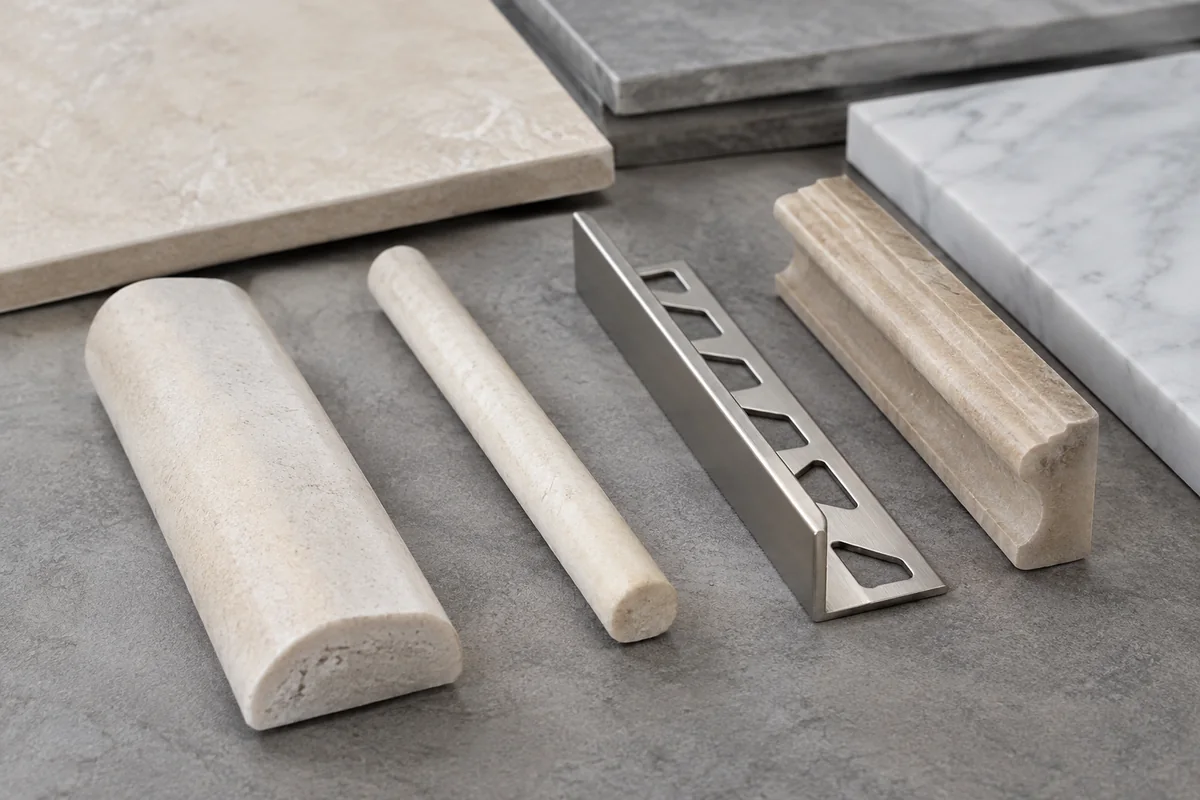
Bullnose tile
A bullnose tile has a rounded, finished edge that turns down or outward from the tile face. It is often used to create a soft stopping point on a backsplash, wainscot, shower wall, or other tiled surface. Bullnose can be made from the same visual family as the field tile, which helps produce a coordinated border.
Its main advantage is continuity: the edge is usually less visually assertive than a contrasting metal or decorative molding. The limitation is availability. Not every tile collection has a matching bullnose, and a field tile may not be designed to produce a clean finished edge when cut.
When comparing bullnose edge options, check whether the profile matches the field tile in color, surface character, thickness, and intended orientation. With natural stone, variation in color, veining, and movement means a trim sample may not represent every piece in the finished installation.
Pencil liner
A pencil liner is a narrow, rounded or semi-rounded molding used as a border, transition, or termination detail. It can frame a decorative tile area, define the edge of a backsplash, or create a slim visual separation between materials. Pencil liners are available in different stones, ceramics, and other finishes, so they can either blend with the tile or provide contrast.
Because pencil liners are narrow, they draw attention to alignment. Uneven substrate conditions, inconsistent grout joints, or a layout that ends awkwardly can be more noticeable beside a linear molding. Plan the liner as part of the overall layout rather than treating it as an afterthought.
For a specific product example, the Bardiglio pencil liner trim can be reviewed as part of the process of comparing narrow molding styles. Product dimensions, material details, finish, and installation suitability should be confirmed on the product page and with the installer before ordering.
Another example to compare is the Iceberg marble pencil liner. Since natural marble can vary from piece to piece, review samples and the project’s full material palette before deciding whether a particular molding will blend with the surrounding tile.
Metal edge profiles, including Schluter-style trim
Schluter is a well-known brand name that is often used informally when people search for metal tile edge trim. More broadly, metal edge profiles are a product category designed to create a defined transition at an exposed tile edge or outside corner. They are commonly selected when a project calls for a slim, contemporary line instead of a rounded stone or ceramic molding.
Metal profiles can be visually subtle or intentionally contrasting, depending on the finish and surrounding materials. They require careful planning at corners, intersections, and end points. The profile must also be compatible with the tile thickness and installation method; the appropriate detail is system- and product-specific rather than universal.
One trade-off is that a metal profile remains visually distinct from the tile. That can be an advantage in a modern design, but it may look out of place if the rest of the room relies on a continuous stone or ceramic border. Compare samples in the actual lighting whenever possible.
Stone or ceramic molding
Stone and ceramic moldings include more shaped profiles than a simple pencil liner. Depending on the collection, a molding may have a stepped, coved, rounded, or other decorative form. These profiles can establish a traditional border or provide a more substantial transition than a narrow liner.
Their appearance is closely tied to the surrounding tile. Natural stone moldings may show variation in shade, veining, texture, and movement, while ceramic pieces may have more intentionally coordinated color but still require attention to batch and finish matching. Ask how the molding is intended to meet at corners and whether additional pieces are needed for the planned layout.
Mitered or finished tile edges
A mitered edge is formed by cutting adjoining tiles so they meet at an angle, often at an outside corner. A fabricator or experienced tile installer may also finish the exposed edge of stone or porcelain through a suitable edge treatment. This approach can create a relatively continuous appearance without adding a separate trim piece.
The result depends heavily on accurate cuts, consistent tile thickness, corner geometry, and installer skill. It can also make small layout or alignment errors more visible. Before choosing this route, confirm that the tile and installation plan are appropriate for the proposed edge detail.
How to choose the right edge trim
Start with the location and the design goal, then narrow the choice using practical constraints. These questions usually clarify the decision:
- Where is the exposed edge? A backsplash end, outside corner, floor transition, niche, stair edge, and shower wall may call for different visual and installation details.
- Should the trim blend in or stand out? Matching bullnose or stone molding tends to read as part of the tile field. Contrasting metal or decorative trim makes the edge more noticeable.
- What is the actual tile thickness? Profiles and moldings must relate properly to the tile and setting materials. Do not select by appearance alone.
- How will corners be handled? Review outside corners, inside corners, ends, returns, and intersections before purchasing. A profile that looks good in a straight run may need a different detail at a corner.
- How does the edge meet another material? Consider the change to paint, stone, cabinetry, wood, carpet, or another tile. The transition should be intentional and not leave an unfinished sliver or awkward gap.
- How much maintenance and visual variation is acceptable? Natural stone can require material-specific care and will not have perfectly uniform color or pattern. Review care guidance for the selected material rather than assuming all tile and stone behave the same way.
Common planning mistakes to avoid
Choosing trim after the tile is installed
Waiting until the end can limit the available options, especially when a collection has no matching edge piece. Include the edge treatment in the layout and material estimate before installation begins.
Ignoring the finished height
An edge profile has to relate to the finished tile surface, not just the tile body. Setting materials and the surrounding construction can affect the final relationship. Confirm the detail with the installer and the applicable product instructions.
Forgetting transitions and returns
A straight edge is only one part of the installation. Determine how the trim will end, turn a corner, meet cabinetry, or transition to another surface. These small details often have a greater effect on the finished appearance than the profile name itself.
Assuming a sample represents all natural stone
A sample is useful for reviewing general color, finish, and scale, but it cannot show every piece of a natural-stone installation. Discuss expected variation and inspect material before installation when project conditions allow.
A practical way to compare options
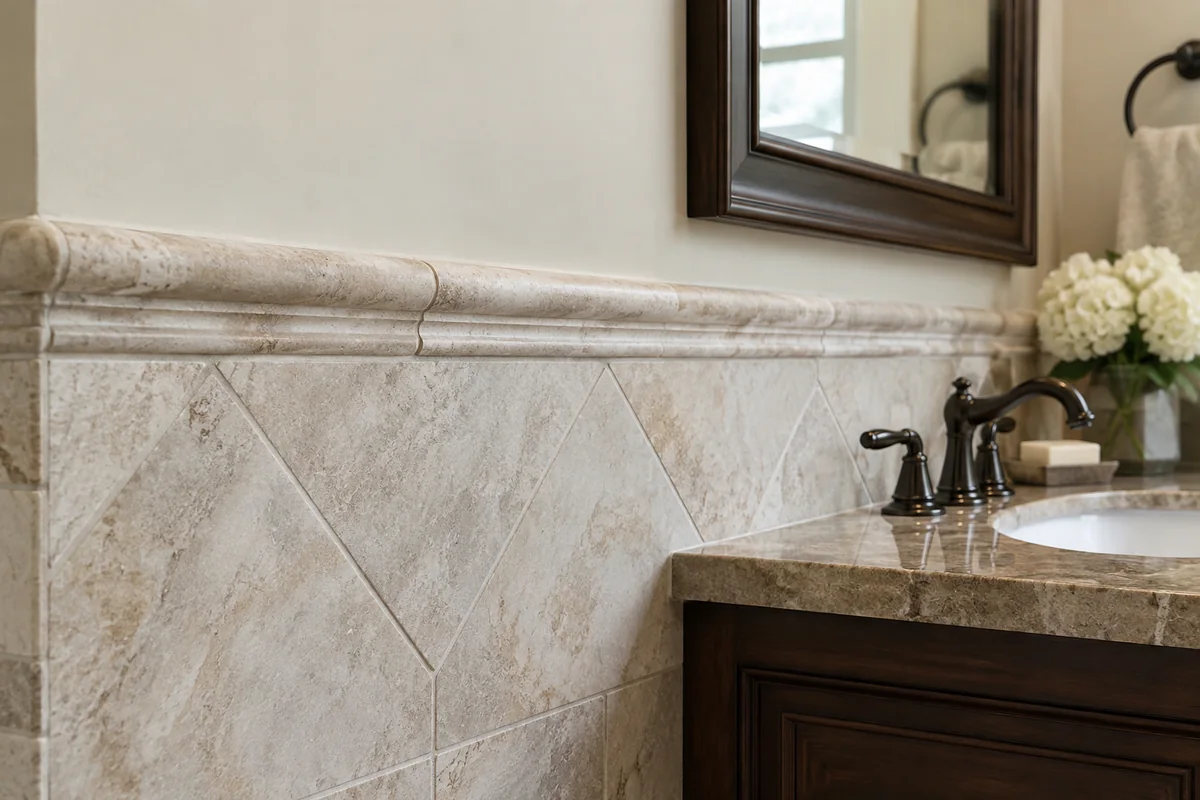
Before ordering, create a simple edge plan showing each exposed side, corner, transition, and termination point. Mark the field tile, the proposed profile, and the adjoining surface. Then compare physical samples for color, thickness, finish, and visual weight.
For a straightforward coordinated edge, matching bullnose may be the first option to investigate. For a narrow decorative border, a pencil liner may be more appropriate. For a crisp contemporary transition, a metal profile or carefully planned miter may fit better. The best choice is the one that works with the tile thickness and layout as well as the desired appearance.
Frequently asked questions
Practical answers to common questions around selection, installation, care, and project planning.
Is bullnose tile required for every exposed edge?
No. Bullnose is one way to finish an exposed edge, but a pencil liner, metal profile, stone molding, or finished tile edge may be appropriate depending on the location, tile, and design.
Can a pencil liner be used instead of bullnose?
Often, a pencil liner can serve as a visual termination or border, but the correct choice depends on the layout, dimensions, material, and how the edge meets adjacent surfaces. Confirm the planned detail before installation.
Is Schluter trim only for modern designs?
No. Metal profiles are commonly associated with contemporary interiors, but the finish and placement determine how prominent they appear. The key considerations are compatibility, corner treatment, and whether the metal should blend with or contrast against the tile.
How do I finish a tile edge without trim?
Depending on the tile and installation, an installer may use a mitered corner or another finished edge treatment. This requires careful planning and should be evaluated for the specific material and location.
Final considerations
Tile edge trim types are best compared as part of the entire installation, not as isolated decorative accessories. Identify every exposed edge, verify the relationship to the tile thickness, plan corners and transitions, and review samples before committing. If the project uses natural stone, allow for variation and follow care guidance specific to that material. A qualified installer can also help confirm whether the selected profile suits the tile, substrate, and proposed installation detail.
Find the Right Tile or Stone for Your Project
Browse Stone Market USA collections or contact our team for help comparing materials, finishes, applications, samples, quantities, and current availability.