

Natural Stone Etching vs. Staining vs. Efflorescence: How to Identify the Problem
Discoloration on a stone floor, backsplash, countertop, or wall can have several different causes. A pale ring may be an acid etch rather than a stain. A white, dusty film may be efflorescence rather than grout residue. Treating the wrong problem can make the surface look worse or leave the underlying moisture issue unresolved.
The key is to identify whether the change is primarily on the surface, inside the stone, or caused by salts moving through a damp installation. This guide explains the difference between natural stone etching, staining, and efflorescence, along with practical clues to check before choosing a cleaning method or calling a stone-care professional.
The basic difference between the three problems
Material Guidance
How to recognize etching
Material Guidance
How staining differs from etching
Material Guidance
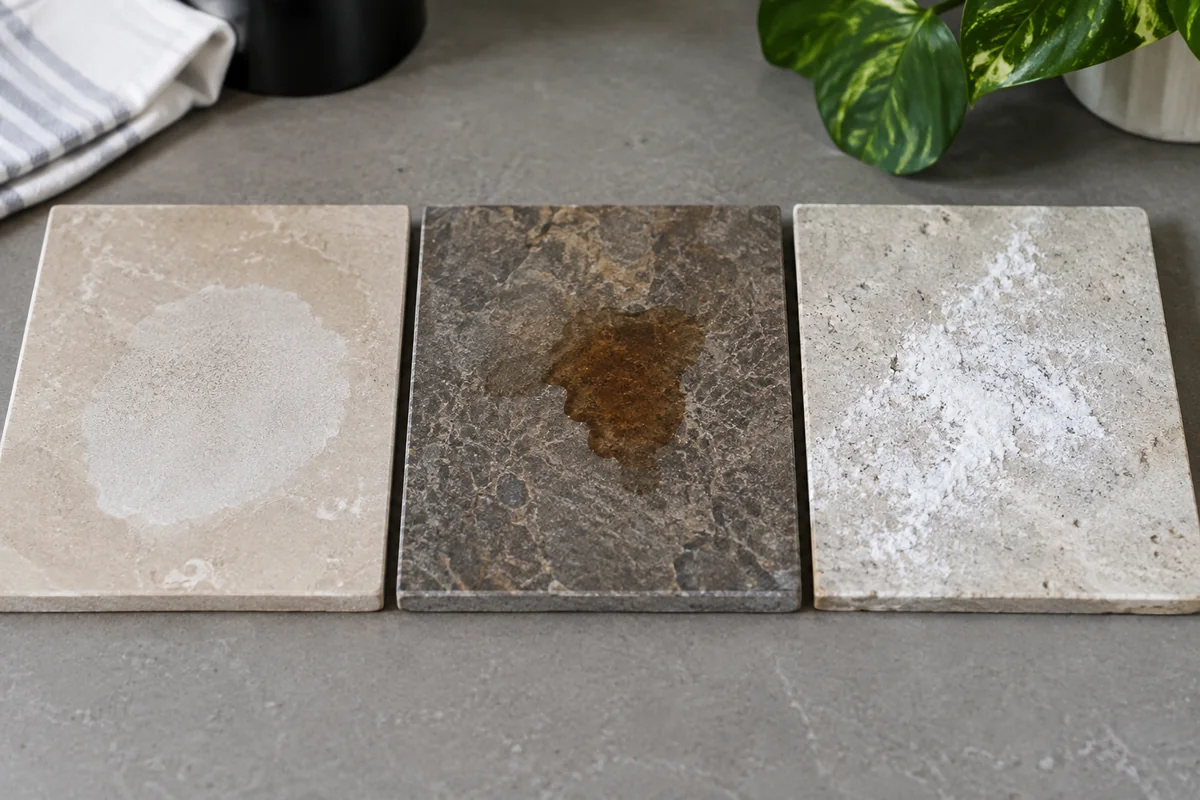
The basic difference between the three problems
Although the symptoms can overlap, these conditions are not the same:
- Etching is a chemical change to the surface of an acid-sensitive stone. It commonly appears as a dull, lighter, or less reflective spot.
- Staining is unwanted color that has penetrated or remained within the stone, often from an absorbed liquid or material.
- Efflorescence is a deposit of water-soluble mineral salts that has traveled toward the surface with moisture and dried there, usually leaving a white or pale powdery or crystalline residue.
The stone type matters. Marble, limestone, travertine, and other calcium-based stones can be sensitive to acidic substances, while all porous materials may be vulnerable to some types of staining or moisture-related deposits. Even within one stone category, finish, porosity, grout, installation conditions, and the substance involved can change the appearance.
How to recognize etching
Etching usually looks like a change in the stone’s finish rather than a colored substance sitting on or inside it. On polished stone, the affected area may appear dull, hazy, or less reflective than the surrounding surface. On a honed finish, the change may be less obvious visually but can still appear as a lighter or slightly rougher-looking patch.
Common causes include acidic foods and drinks, acidic cleaning products, and other low-pH substances. Lemon juice, vinegar, wine, tomato-based liquids, and some bathroom or household cleaners can react with acid-sensitive stone. The exact result depends on the stone, finish, concentration, contact time, and whether the surface has been previously altered.
Clues that a mark may be an etch
- The spot is dull or cloudy but does not look like a separate colored deposit.
- The outline may match a dropped liquid, glass, bottle, or cleaning splash.
- Wiping the area does not remove the change.
- The affected area may be easier to see from an angle or under reflected light.
- The mark is often on the surface finish, not deep discoloration within the stone.
Sealing does not make acid-sensitive stone etch-proof. A sealer may affect absorption and stain resistance, depending on the product and stone, but it does not prevent an acidic substance from reacting with a vulnerable mineral surface.
How staining differs from etching
A stain is primarily a color change. It may appear brown, yellow, gray, pink, green, or nearly black, depending on what caused it. Common sources can include oil and grease, coffee, tea, food, cosmetics, organic debris, dyes, and rust-related discoloration. Water can also reveal an existing problem by darkening a porous area temporarily, although a damp spot is not automatically a permanent stain.
Unlike an etch, a stain may remain visible even when the stone’s sheen and surface texture are otherwise unchanged. A polished surface can still look reflective around a stained area. However, the two conditions can occur together: an acidic liquid may etch the surface while also carrying pigment or oil into the stone.
Questions to ask when investigating a stain
- Is the discoloration associated with food, oil, rust, plant material, cosmetics, or a colored liquid?
- Does it extend beyond the original spill or follow grout lines and edges?
- Is it darker when the stone is damp and lighter as it dries?
- Does the area have an odor, residue, flaking material, or change in texture?
- Could the discoloration be coming from below the stone rather than from a recent surface spill?
Different stains require different approaches, and a cleaner suitable for one type of discoloration may be ineffective or damaging for another. Avoid mixing cleaning chemicals or applying an aggressive treatment before identifying the likely source.
How to recognize efflorescence
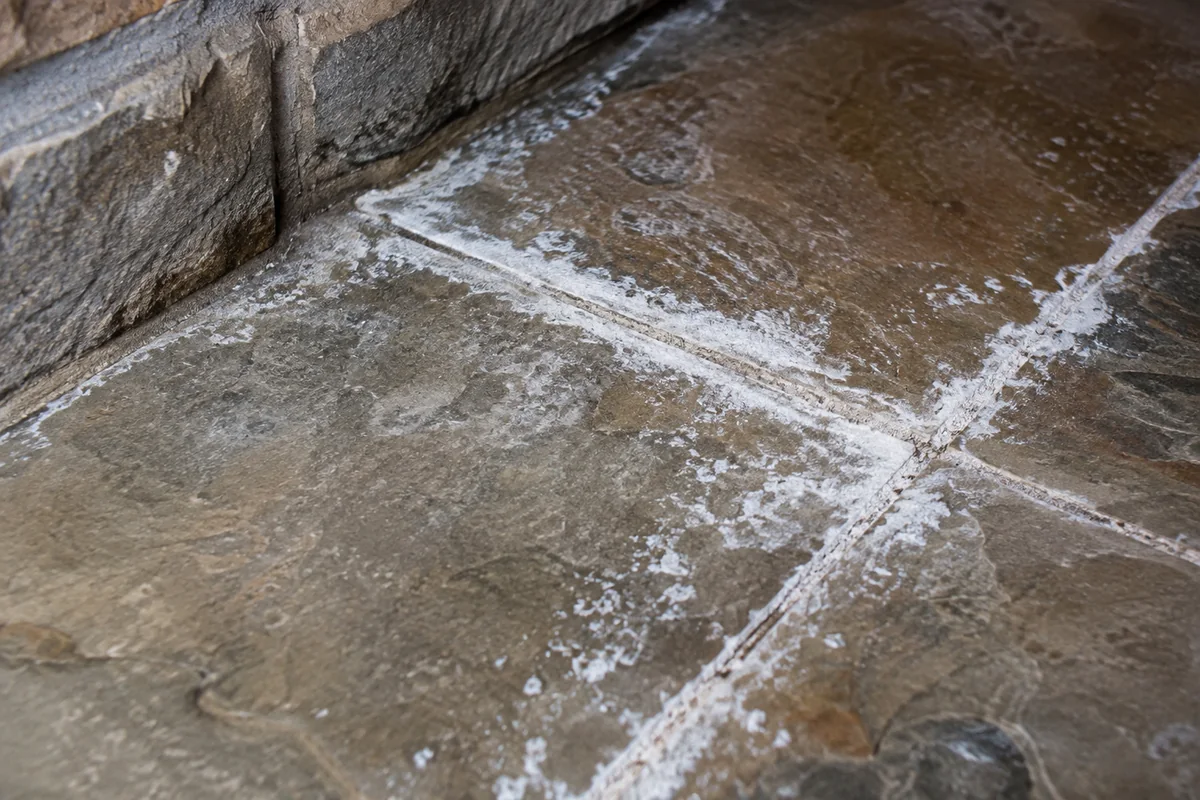
Efflorescence is generally associated with moisture moving through a porous masonry or tile assembly. As water travels through the setting bed, grout, mortar, concrete, or adjacent materials, it can carry dissolved salts. When the water reaches the surface and evaporates, the salts may remain as a white, grayish, or pale powdery film or crust.
It commonly appears along grout joints, at the edges of a floor or wall, near transitions, or in areas that dry slowly. The residue may return after cleaning if moisture continues to move through the assembly. That recurring pattern is an important distinction from ordinary surface dirt.
Clues that a white deposit may be efflorescence
- The material looks powdery, chalky, or crystalline rather than like a flat change in color.
- It is concentrated near grout joints, edges, corners, or other paths where moisture may travel.
- It can reappear after being removed.
- The installation has experienced recent grouting, cleaning, water exposure, leakage, or drying.
- The residue may brush or wipe away more readily than an etch or embedded stain.
Not every white mark is efflorescence. It could also be grout haze, hard-water residue, surface dust, sealer residue, or mineral buildup. Because acidic cleaners can damage acid-sensitive stone, identification should come before treatment.
A practical way to compare the symptoms
When deciding between natural stone etching vs staining vs efflorescence, examine the mark under good light and consider its location, texture, and response to gentle cleaning.
- Look at the color. A dull, pale change with no obvious residue suggests etching. Strong or unusual color suggests staining. White or pale powder suggests a mineral deposit, including possible efflorescence.
- Check the texture without scraping. A surface deposit may feel removable, while an etch is a change in the finish. Do not use a blade or abrasive pad to test it.
- Study the pattern. A ring or splash outline may point to a spill. A mark following grout, edges, or low areas may indicate moisture movement.
- Try only a gentle first step. Use a clean, soft cloth and a stone-safe cleaning method appropriate for the surface. If the appearance does not change, stop escalating treatments at random.
- Observe recurrence. A deposit that returns is a reason to investigate moisture, not simply repeat surface cleaning.
Test any proposed cleaning method in an inconspicuous area first, and follow the instructions for the specific stone-care product. A small sample or hidden section can reveal whether a product changes the finish, but it cannot reproduce every condition in an installed surface.
Once the cause is understood, a consistent natural stone tile maintenance routine can help reduce new spills, residue, and avoidable cleaning damage. Maintenance cannot correct every existing defect, but it can make future changes easier to identify.
What treatment may involve
Etching may require restoration of the affected finish rather than a conventional stain remover. Depending on the stone and finish, that work can involve honing, polishing, or another professional surface-restoration process. The correct method is project-specific, so a stone restoration professional is a sensible choice for prominent areas, large etches, or uncertain stone types.
Staining may sometimes respond to a poultice or another treatment selected for the suspected staining material. Results are not guaranteed, particularly when the source is unknown, the stain is old, or discoloration has migrated deeply. Do not assume that applying more sealer will pull out an existing stain.
Efflorescence requires attention to both the visible deposit and the moisture conditions that support it. Gentle removal may be possible once the surface is dry, but recurring efflorescence can point to water entering, traveling through, or leaving the installation. The appropriate investigation may involve the grout, substrate, nearby plumbing, exterior exposure, or installation details. A qualified installer or other appropriate professional can help determine what needs to be evaluated.
The appearance of a surface also affects how a problem is perceived. If you are comparing honed and polished stone finishes, remember that reflection can make etching easier to notice on polished material, while a honed finish may show changes through tone or texture instead. Neither finish eliminates the need for appropriate care.
Common mistakes to avoid
- Using vinegar or lemon to remove a white mark. An acidic substance can worsen etching on acid-sensitive stone.
- Assuming every dark spot is a stain. Moisture, shadowing, surface texture, or a finish change can create a similar appearance.
- Scrubbing with abrasive tools. Aggressive pads can alter the finish and create a larger visible area.
- Sealing before diagnosing the problem. Sealer is not a cure for etching, active moisture, or every type of discoloration.
- Ignoring recurring deposits. Repeated efflorescence deserves attention to the source of moisture.
- Testing several products at once. Mixed treatments make it harder to determine what worked and can create additional residue or damage.
When to seek professional help
Consider professional evaluation when the stone type is uncertain, the affected area is extensive, the mark keeps returning, the installation may have a moisture problem, or the finish has visibly changed. Professional help is also useful when the surface is valuable, difficult to replace, or located in a prominent area where an uneven repair would be noticeable.
Before treatment, document the location and appearance, note what may have contacted the surface, and photograph the area in consistent lighting. Share any cleaning products already used. These details can help distinguish a surface reaction from absorbed discoloration or a moisture-related deposit.
Final takeaway
Etching changes the stone’s surface finish, staining changes its color, and efflorescence leaves salts behind as moisture evaporates. The most reliable diagnosis comes from looking at the mark’s color, texture, pattern, location, and tendency to return—not from applying increasingly strong cleaners. Start with the least aggressive approach, protect the stone from acidic or abrasive products, and investigate recurring moisture-related deposits before treating them as ordinary dirt.
Frequently asked questions
Quick answers to practical selection, installation, care, and planning questions.
Can efflorescence permanently damage natural stone?
The visible residue is not the same as an etch, but repeated moisture movement and unsuitable cleaning can create additional problems. If efflorescence returns, the moisture source and installation conditions deserve attention.
Can a sealer remove a stain?
No. A sealer may help limit absorption when appropriate for the stone and application, but it does not remove an existing stain and does not prevent etching.
Is a dull spot always an etch?
No. A dull spot can also result from abrasion, residue, wear, or an altered finish. Acid contact is one possible cause, especially on acid-sensitive stone.
Should I use an acidic cleaner on a white deposit?
Not without identifying the stone and the deposit first. An acidic cleaner may damage acid-sensitive materials, and the white residue could be something other than efflorescence.
Find the Right Tile or Stone for Your Project
Browse Stone Market USA collections or contact our team for help comparing materials, finishes, applications, samples, quantities, and current availability.