Nationwide Shipping
Product Samples Available
Premium Natural Stone & Porcelain
This is one of the most common (and most stressful) questions we hear from homeowners, designers, and contractors: “If I buy the same stone later, will it match?” Sometimes the answer is yes. Very often, it’s close—but not identical. And occasionally, it’s noticeably different.
The tricky part is that natural stone doesn’t behave like paint or wallpaper. It’s not “manufactured” into a perfect, repeatable color. It’s taken from the earth in layers, with real mineral variation, movement, and veining. That uniqueness is exactly why people love it— but it’s also why reorders can be risky if the project isn’t planned with a little breathing room.
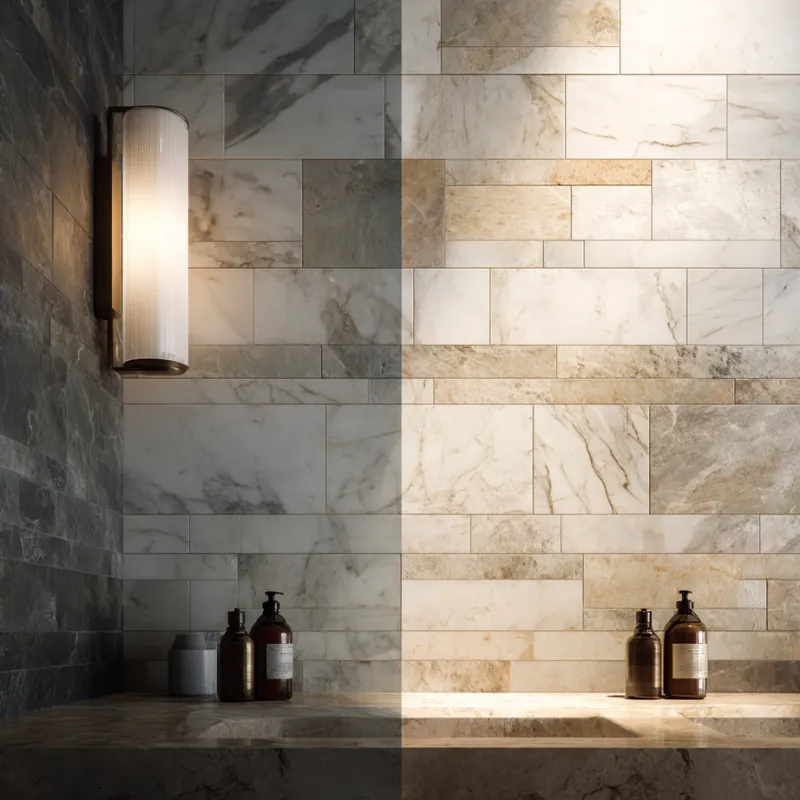
The same natural stone can look lighter or warmer depending on lighting, shadows, and surrounding finishes.
In the stone world, product names can be misleading if you treat them like paint codes. Two boxes labeled “Beige Marble” (or even the exact same stone name) might be cut from different blocks, different layers of the quarry, or processed at different times. That doesn’t mean something went wrong—it’s simply how natural materials work.
Even if your reorder comes from the same general source, small shifts in mineral content or veining can change the overall “read” of the stone. And here’s the twist most people don’t realize until install day: lighting can amplify those differences. Warm indoor lights can pull stone toward honey/gold tones, while daylight may make the same surface feel cooler or greyer.
So if you reorder months later and it looks “off,” it might not be a bad batch—it might be a different quarry block, a different finish lot, or simply the reality of natural variation being more visible in your specific space.
Let’s break down the most common reasons reorders don’t match perfectly. None of these are rare—they’re normal in natural stone. The key is knowing what they are, so you can plan around them.
Natural stone is extracted in blocks. Each block is unique, and even blocks from the same quarry can look meaningfully different. One layer might be cleaner and lighter; another might be warmer, more veined, or more clouded. If your reorder is cut from a different block (or even a different layer), the overall tone can shift.
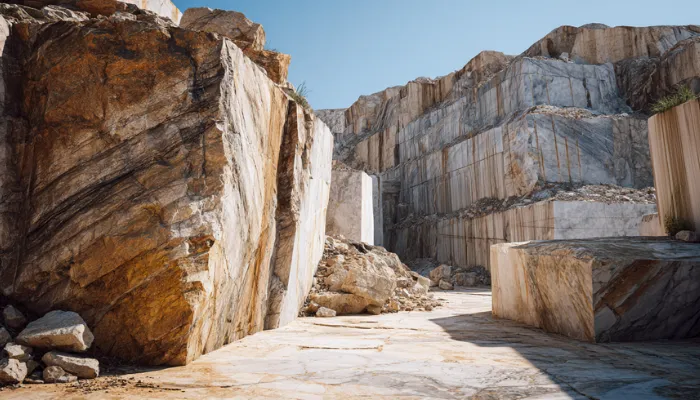
Color differences often start at the quarry: different layers and blocks can produce different tones.
Stone tile is produced in batches—cutting, finishing, and packaging happen over time. If you reorder later, the material might come from a newer shipment or a different production run. Even if it’s “the same stone,” the batch can vary in background tone, veining intensity, or surface character.
That’s why installers and designers often talk about “lot” or “batch” consistency. When you order everything you need at once, you dramatically improve your odds of a cohesive look across the entire project.
This is especially important for large surfaces like open-plan flooring or long shower walls where small variations become very noticeable.
Honed, polished, and tumbled surfaces can make the same stone appear different. A polished finish reflects light and often looks deeper or slightly richer. A honed finish reads softer and more matte. If your first order and reorder were finished at different times—or come from different lots—the sheen may not be identical, even if the label is.
Stone is famously sensitive to its surroundings: grout color, adjacent paint, cabinetry tone, and lighting temperature can all change how it looks. That’s why a reorder might appear “wrong” when you compare it to an already-installed section. In many cases, the difference is real—but the contrast is also amplified because your eye is comparing two areas directly side-by-side.
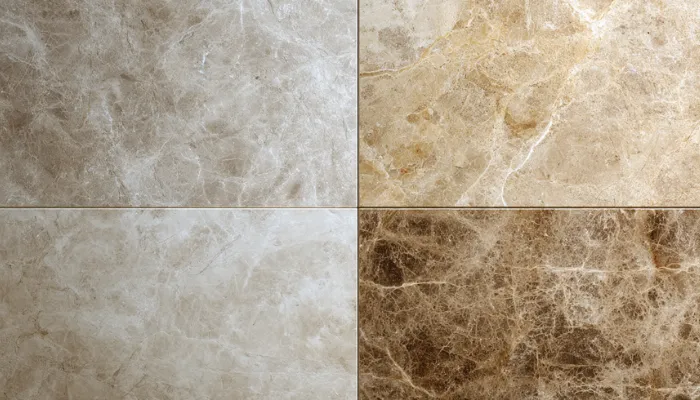
Reorders may come from a different batch, which can shift shade and overall tone.
In practice, mismatches tend to happen in a few predictable scenarios. If any of these sound familiar, you’re not alone.
The smaller the patch, the more your eye notices it—especially on large, calm stones where the background tone matters. That doesn’t mean reorders are impossible. It just means you want a strategy, not hope.
The best solution is planning. Here are the steps that make the biggest difference—whether you’re a homeowner ordering once, or a designer managing multiple spaces on a tight schedule.
If consistency matters, treat your order like a single “moment in time.” Ordering all the required tile at once increases the chance it ships from the same batch and looks cohesive across the finished space.
Most reorders happen because the project ran short. The simple fix is to order extra up front. Waste depends on layout, tile size, pattern, and how many cuts are required, but as a general rule:
That extra material is your insurance policy. It’s usually far less expensive than trying to blend a reorder later.
If you can, store a small amount of leftover material (clean, dry, and labeled). If a repair is needed later, you’ll have the closest match. This matters most for shower walls, backsplashes, and floors that might need future access repairs.
If a reorder is unavoidable, a clean “design break” can make the difference feel intentional: use a trim, a border, a change in direction, or a shift to mosaic as a transition. Instead of fighting a slight shade change, you frame it as a planned detail.
In many cases, mosaics can be slightly more forgiving because the pattern breaks up large fields of color. That said, mosaics still come from batches, and the stone chips can vary. Large-format field tiles are usually less forgiving because your eye reads the background tone across a bigger area.
If you’re still choosing materials and long-term consistency is a priority, start by browsing a curated selection of field tiles and mosaics, and then plan your quantities carefully: Shop Tiles and Shop Mosaic Tiles.
You can reorder the same stone, but the most realistic expectation is: you can usually get a similar look—not a guaranteed match. Natural stone is wonderfully unique, which means it can shift between blocks, layers, and batches. The goal isn’t perfection—it’s a project that looks cohesive and intentional.
If you’re planning a remodel and want the best odds of consistency, the smartest approach is to select your stone, confirm your design direction, and order the full quantity (plus a reasonable waste factor) at one time. It’s the simplest way to avoid last-minute stress—and it usually saves money in the long run.
Natural stone will always have variation—that’s its charm. The win is planning your project so that variation feels beautiful, not accidental. When you order smart, keep a little extra, and design with real-world realities in mind, your space ends up looking higher-end—not patched together. And if you ever need help choosing between tile and mosaic options, you can start here: Tiles | Mosaic Tiles.